


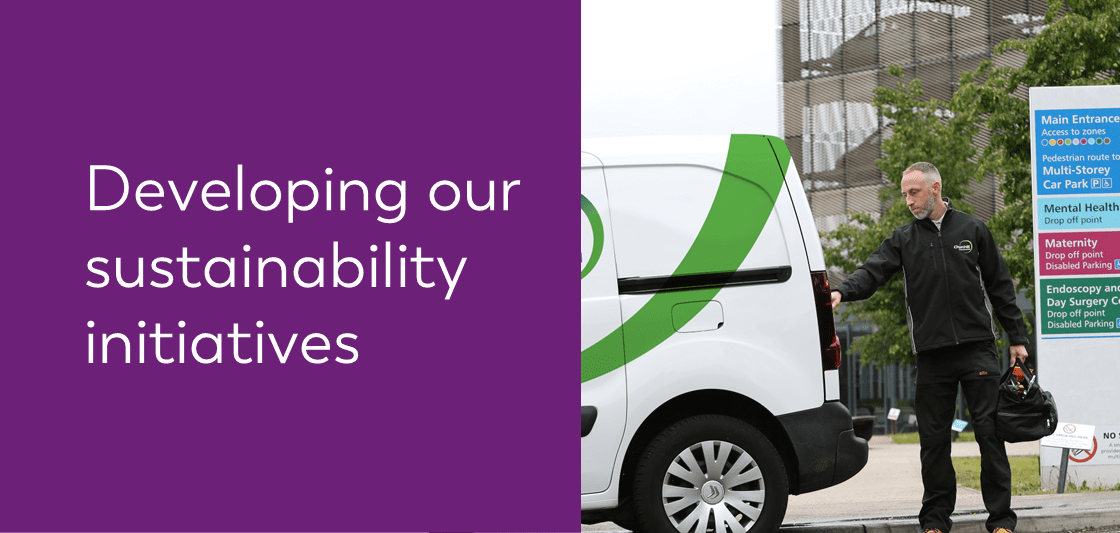
An exciting time awaits at Churchill Group as we embark on new sustainability initiatives. These developments focus on the ‘E’ and ‘S’ of our Environmental, Social, and Governance (ESG) framework. We are improving our energy management and efficiency. We are also enhancing our sustainable employment initiatives.
In April, the Science Based Targets initiative (SBTi) validated our science-based greenhouse gas (GHG) emissions near-term reduction targets. We have been working hard to improve our energy efficiency to meet its standards.
Social value and energy management are important to our business. They help create a more sustainable future for our people and the planet. Here’s a recap of recent developments.
Energy Management Initiatives
Electric Vehicle (EV) fleet
We aim to switch about 1,000 fleet vehicles from gas engines to electric by 2032 as part of our SBTi targets. Electric vehicles are a pivotal part of our GHG reduction work.
In 2024, our EV fleet grew by 34%. This led to a 15% drop in emissions from the Churchill Group fleet. This shows we are on track to meet our long-term EV goal.
We have added new telematic devices to 80 vehicles in our fleets. These devices share better telecommunications and information directly from the vehicles. This way, we can track how our vehicles are used. We can analyse downtime, routes, stops, and energy use.
This will help us do thorough feasibility assessments for future EV use. We can also improve vehicle networks to increase EV efficiency. This includes creating routes with the best charging port locations.
We are also FORS Bronze accredited on a significant portion of our fleet. The FORS (Fleet Operator Recognition Scheme) standard measures fleets on safety, efficiency, environmental protection and overall performance. It requires us to monitor vehicle fuel consumption, route optimisation, carbon emissions and other non-GHG emissions like nitrogen or particulate matter. This will help us strategise how best to convert to a larger, cleaner and more efficient EV fleet.
Site-wide energy management
Our EV work is part of our larger energy transformation program. This program includes energy reviews at all our locations. We have done detailed reviews of energy use patterns. This includes checking half-hourly energy data for sub-metered locations.
For example, we have tracked our key energy performance indicators (EnPI) in all locations. This helps us analyse and compare our energy use and efficiency to help us reduce our energy consumption.
The Churchill Energy Management Team has worked closely with site teams for the last 4 years. They found potential energy savings of £43,000 in office and depot buildings. When combined with the realised 0.2 kWh/mile fleet efficiency improvement these savings demonstrate the value of implementing an accredited Energy Management System such as ISO 50001.
We have kept our ISO 50001 Energy Management System certification since 2015. Each year, an external auditor visits us. They check that we make continuous improvements, which is a basic requirement of all ISO standards.
ISO 50001 is also our chosen route for compliance with the Energy Saving Opportunity Scheme (ESOS) regulations, the government energy assessment scheme for businesses which consume significant quantities of energy. The ESOS assessment is required every four years, and we calculate Churchill Group’s total energy consumption and identify areas of significant consumption by referencing the outputs from our ISO 50001 Energy Management System (EnMS).
Energy management dovetails nicely with our recently validated Science-Based Targets. Tackling Climate Change requires ambitious action from the FM sector and we are committed to halving our Scope 1 & 2 emissions by 2032. These Scope 1 and 2 emissions are overseen in effect by our ISO 50001 EnMS as it keeps our fleet consumption and site electrical consumption in check. We have also committed that 95% of our suppliers will also have science-based targets themselves, helping to broaden our environmental impact.
Environmental Initiatives
Waste Management
In 2024, we continued to enhance the quality of data on the waste produced by our sites, which made it possible to further decrease the amount of waste we sent to landfill sites from 95% to 98%. We continue to work closely with our waste management partners to remain compliant with new waste management regulations, as well as work to increase waste recycling rates across our client sites. This year, recycling rates across our clients increased by 45% alongside a 100% landfill diversion rate.
Social Value Initiatives
Social Value Portal
We joined the Social Value Portal (SVP) to learn about, measure and manage our social value initiatives. SVP developed the National Themes, Outcomes and Measures (TOMs) Framework, endorsed by the Local Government Association. TOMs creates a practical method to measure social value and how organisations contribute to society, providing proxy financial values to social activities. Our collaboration lets us better shape, amplify and measure our social value initiatives and their success.
Social Recruitment Advocacy Group
Churchill Group has been given Gold Member Status by the Social Recruitment Advocacy Group (SRAG). This helps us enhance our social value initiatives in the FM industry. The industry spends about £3.5 million on social value for each project.
Social Recruitment Advocacy Group (SRAG), created by PeoplePlus, which recognises organisations like Churchill Group to support inclusivity in their recruitment methods. SRAG supports businesses to make a positive difference to society and awards accreditations based on their continuing commitments to inclusive hiring practices. We are also co-signatories on the Social Recruitment Covenant, PeoplePlus’ initiative to support employers to hire from disadvantaged groups. Our work together will help make the workforce a fairer place.
After joining the Social Value Portal, we integrated our ESG dashboard with it. This lets us track progress in real-time and show measurable impact.
We already work on many projects to create employment opportunities for individuals from diverse backgrounds. For example, our partnership with West Lea has helped us hire young people. They are neurodiverse and aged 16 to 24. This was done through a Supported Internship Programme.
As signatories of the Armed Forces covenant, we are committed to offering opportunities for ex-military personnel, as well as for young people who come from a care background to continue to promote inclusion within our workplace.
Our partnership with the social enterprise Northern Rights helps disadvantaged people who have struggled to find sustainable employment. The partnership has a high success rate for recruitment and retention, with 51 candidates recruited so far.
Conclusion
Working with SBTi goals, SVP and SRAG will allow us to enhance our sustainable and social value work to support the communities we operate in. These initiatives show new ways we are taking to create a sustainable future for our people and our planet.
Discover more about our ESG goals today.